
Fading Greenness: A Warning from the Deep
A new study has revealed that Earth’s oceans are gradually losing their natural green tint — a subtle yet alarming indicator that global warming is altering marine life.
The research, published on October 17 in Science Advances, found that the ocean’s chlorophyll concentration — a measure of phytoplankton abundance — has been declining over the past two decades. Phytoplankton, the microscopic organisms that give the ocean its green hue, are the foundation of the marine food chain, feeding everything from small fish to massive whales.
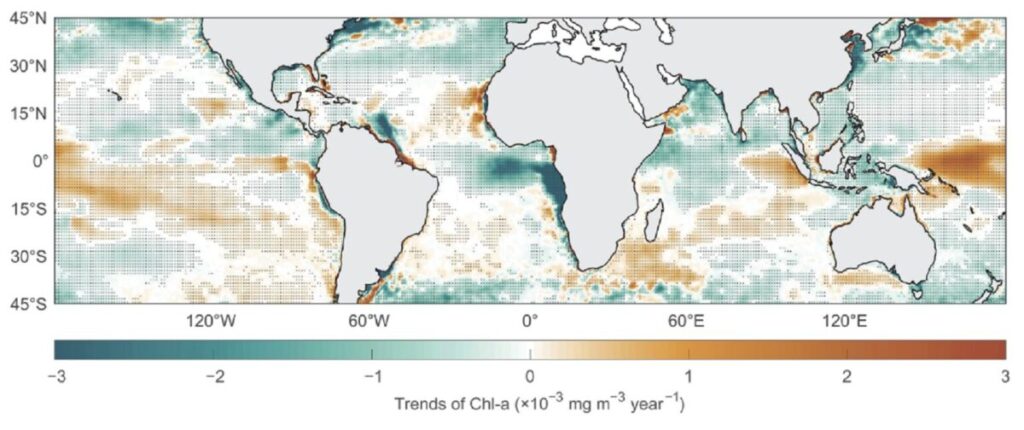
“These changes will profoundly affect the magnitude and distribution of marine ecosystem functioning,” wrote the authors, most of whom are from Tsinghua University in Beijing.
Why Ocean Color Matters
Phytoplankton act like the ocean’s plants — they photosynthesize using sunlight, creating oxygen and absorbing carbon dioxide. When their population declines, the entire food web begins to tremble.
Princeton University geoscientist Curtis Deutsch, who was not part of the study, told Mongabay that the trend is “not good.” He noted that less greenness “almost certainly means less production of new organic matter,” meaning fewer algae and less food for marine life.
AI Models Reveal the Trend
To paint a global picture, the research team used satellite data, sea surface measurements, and AI-based modeling to estimate chlorophyll levels between 2001 and 2023.
Their findings show a steady loss of greenness — about 0.00035 milligrams per cubic meter per year, and nearly twice that rate in coastal regions. Low- to mid-latitude waters, which include tropical and subtropical seas, were hit hardest.
“The low- to mid-latitude oceans are becoming progressively less green,” the authors wrote, pointing to regions like the west coast of Africa, where ocean productivity is falling faster than average.
The Hidden Link: Warmer Seas and Weaker Life
Rising sea surface temperatures are creating stronger ocean stratification — separating surface waters from nutrient-rich depths. This limits the upwelling that phytoplankton depend on to survive.
When phytoplankton decline, so does the ocean’s ability to store carbon. For decades, the ocean has acted as a carbon sink, absorbing roughly a quarter of all human CO₂ emissions. A weaker phytoplankton population could mean the ocean’s natural defense against climate change is eroding.
Ripple Effects for Fisheries and Food Security
The findings carry serious implications for coastal communities and global fisheries. “It could have a very large impact on the fishery industry,” said study co-author Professor Di Long of Tsinghua University.
If phytoplankton continue to dwindle, it could threaten the food security of millions who depend on the ocean’s productivity. Regions already vulnerable to overfishing or warming waters — such as West Africa and Southeast Asia — may face even tougher challenges.
The Color of the Future
Although more research is needed to confirm how these trends affect carbon storage and fisheries long-term, scientists agree that the decline in ocean greenness is a clear signal of change.
“I think it can inform researchers and policymakers to consider the cascading factors of global warming,” Long said, urging leaders to adopt stronger climate and emission policies.
As the ocean’s colors fade, it’s becoming increasingly clear that what happens beneath the waves will shape life above them.
Source: Mongabay.com (Article licensed under CC BY-ND 4.0)